
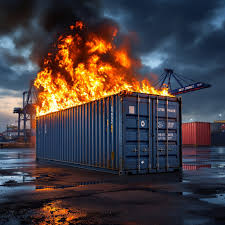
Container ship fires represent one of the most significant safety and financial risks in the maritime industry, with incidents escalating in severity due to larger vessel sizes and the increasing transport of hazardous goods. These fires often occur on deck or in cargo holds, commonly stemming from the misdeclaration of cargo, and can burn for days, causing massive, long-lasting damage.
Key Highlights
- Rising Frequency & Severity: Container vessel fires are increasing, with some estimates suggesting a major fire every 9 days to 60 days, reflecting a 20% increase in incidents over 2024-2025.
- Leading Causes: The primary causes include misdeclared dangerous goods (e.g., chemicals like calcium hypochlorite, charcoal) and, increasingly, the thermal runaway of lithium-ion batteries.
- Massive Scale: Modern Ultra Large Container Ships (ULCS) hold up to 24,000 TEU, making fire detection and access to the seat of the fire extremely difficult for crews.
- Emergency Response Limits: Shipboard firefighting systems are often inadequate for large-scale container fires, often requiring crew to abandon ship, as seen in the Maersk Honam and ASL Bauhinia incidents.
Impact
- Safety & Human Cost: Fires create immediate dangers to crew, including fatal injuries and the need for urgent evacuation, with fatalities in 2025 reaching double figures.
- Environmental Damage: Chemical leaks, oil spills, and plastic pellet contamination (e.g., X-Press Pearl disaster) cause long-term harm to marine ecosystems.
- Financial & Operational Loss: A single large fire can result in hundreds of millions, potentially up to $1 billion, in salvage costs, cargo loss, and damage.
Future Scope
- Regulatory Changes (SOLAS): Industry groups, such as IUMI, are pushing for updates to the SOLAS convention to enhance fire detection and suppression capabilities, including stricter requirements for container stowage.
- Improved Detection Technology: Implementation of advanced sensors, thermal imaging, and artificial intelligence to identify heat signatures within cargo holds earlier.
- Specialized Firefighting Equipment: Adoption of specialized tools like container penetration devices (e.g., HydroPen) that can be operated by the crew to fight fires inside a container.